Since Beyoncé dropped her new album "Cowboy Carter", western boot sales have increased over 20%. Between the drop of this country album and Taylor Swift's tour, western American boots saw major boosts in sales. This inspired Louis Vuitton to reveal an American Western line during Paris Fashion week. Retailers and industries have already taken notice of the trend. Williams trading analysts Sam Poser upgraded his rating on Boot Barn and raised his price target $33 to $113, a 12% increase. This shows why it is important to keep up with trends, even when it comes to fashion and music, because the celebrities influence on the public can effect the economy in many different ways.
Wednesday, April 24, 2024

Monday, April 22, 2024
EU-Mercosur: So Much More Than a Dead Deal
This article discusses the EU-Mercosur Trade Agreement, negotiations for which began in 1999 and reached an agreement in principle 20 years later. However, almost five years after the agreement, it remains in limbo, with experts questioning its viability. The agreement is significant, as the EU represents 450 million people and Mercosur over 280 million. The new free trade area would account for around 20% of the world's GDP.
The article also highlights challenges, including the EU's bilateral trade deficit, which presents a new obstacle. It also discusses the role of China and other external powers in the deal's strategic significance. Many Europeans believe cultural ties will maintain relations, but geopolitical competition requires more. The article notes opposition within both blocs and the broader strategic interests, especially for the United States.
It discusses the challenges within Mercosur, including Argentina's internal politics, Brazil's stance, and other member states' interests, like Bolivia and Paraguay. The EU's internal dynamics, especially concerning agriculture and trade, are also analyzed. The article concludes that the EU's commitment to trade and international integration is tested by the Mercosur deal's fate. If it fails, it could signal broader challenges for the EU's trade agenda and global influence.
Source: https://www.csis.org/analysis/eu-mercosur-so-much-more-dead-deal
Paris Olympics: Rental Challenges Ahead
https://open.spotify.com/episode/3n9deMMMMMsitZfd5nAzMf?si=1580eccd4a144536
As the Paris Olympics draw near, locals looking to rent out their apartments are facing unexpected hurdles. With a flood of listings hitting the market, prices are dropping, and only a third of available Airbnb rentals have been booked so far for the Games. This surge of listings, along with many residents leaving the city during the event, means there are more apartments available than people looking to rent them, leaving many hosts struggling to find renters.
One such host is Stefania, a banker in Paris, who usually rents out her studio on Airbnb. Despite raising her prices for the Olympic period, she's had trouble finding renters. Many hosts like her are reconsidering their pricing strategies, as the average prices for booked accommodations during the Olympics are much lower than what they initially asked for. With hotels also competing for guests, securing bookings has become a real challenge for Airbnb hosts.
While the short-term rental market faces uncertainties, some experts see a bright side. Short-term rentals offer more flexibility compared to building new hotels, but the current surplus of rentals could lead to disappointment for many hosts. As prices continue to drop and competition heats up, hosts will need to be flexible and plan strategically to navigate these changes in the rental landscape.
Powell Dials Back Expectations on Rate Cuts
Fed Chairman Jerome Powell spoke out last week for the first time since the new inflation numbers came in higher than expected, for the third month in a row.
While the Fed had previously planned to cut interest rates this summer, the stronger-than anticipated inflation indicators have shaken up those plans. This is a clear shift in the outlook of the Fed, as they would like to see these numbers go down before cutting interest rates.
According to Jerome Powell, they would like more time to see the restrictive policies work. The current state of the workforce is strong, and inflation is slowly coming down. Powell also said that there would be no plans of raising interest rates. If the economy were to take a sharp downturn, Powell did say they would lower interest rates.
Most of the financial sector took a hit after the PCE and CPE numbers came out for the month. While Jerome Powell addressed the public, the S&P 500 fell slightly, and 2-year Treasury note yields briefly hit over 5% for the first time since November.
Link: Fed Chair Jerome Powell Dials Back Expectations on Interest-Rate Cuts - WSJ
Mexico Economy to Keep Growing Steadily After June Presidential Vote: Reuters Poll
https://money.usnews.com/investing/news/articles/2024-04-22/mexico-economy-to-keep-growing-steadily-after-june-presidential-vote-reuters-poll
Thursday, April 18, 2024
Russia is expected to grow faster than all advanced economies this year
Russia is expected to grow faster than all advanced economies this year
This article is about Russia's expected growth in the next year and how the International Monetary Fund predicts that it will be the fastest to grow in the coming calendar year. The growth is expected to be 3.2% in 2024 and would be greater than all other larger economies including the United States. This forecast is surprising to Western nations who had hoped to isolate the Russian economy after invading Ukraine in 2022. The article then discusses the self-sufficiency of Russia and how expanded during the war. From a political standpoint, the International Monetary Fund touches on the predicted impacts of the war with Ukraine and affects the political and social standing of Putin as he promises Russians to raise their living standards. Similar to what we discussed in class, Putin plans to raise living standards by spending money on education, healthcare, and public infrastructure which we learned are effective ways of raising the standard of living of a country.
Wednesday, April 17, 2024
How to Plan for a Recession
The idea of experiencing a recession in the future is something that most Americans are used to, especially after everything that has happened in the last four years. This article dives into how to combat such economic downturns so that readers can understand what can be done to escape the negative effects that go along with recessions. The first way to handle the decrease in money supply would be putting your extra cash in a high interest insurance account. Securing an emergency fund, will help with keeping the value of your savings high and reducing the likelihood of needing to borrow because of its liquidity. It is important to note that living within you means during good economic stability will help reduce the need to borrow when food and gas prices rise in economic downturns. The article suggests that trying to live off of one payroll instead of two for married couples is a good habit that will help reduce spending and increase savings for emergencies. Diversifying your income streams was another suggestion which can help increase job security by having multiple places that one can put their extra time into for pay. Next is investing, and just like any good financial advisor this article preaches about investing in the long run and diversifying your portfolio. Diversifying helps with managing risk within the market, making sure you do not invest in one particular section of the economy mitigates the risk of completely loosing everything if that section collapses. They also emphasized the importance of investing for the long run, saying that you haven’t lost the money until you sell, so it is important to be aware that panic is what often leads to even worse situations. When prices are down it is almost like they are on sale, so in some situations it can be beneficial to take advantage of that if you have the means. As long as you are not invested in one place, this will help mitigate any major losses seen throughout the entire economy. As someone who plans to be a part of the workforce in the next two years, I thought this article was helpful in outlining some of the priorities I should be setting for myself.
7 Ways to Recession-Proof Your Life
U.S. economy will see ‘more things break’ in 2025 if rates stay high, strategist says
In this article, it explains how traditional monetary policy is broken in the sense that it takes longer for the economy to see real effects. Another problem that was mentioned is if interest rates stay high into 2025 there could be major problems as many people and companies will be refinancing around that time causing them to feel the effects of high interest rates which on analysis suggested could cause large problems.
https://www.cnbc.com/2024/04/16/us-economy-will-see-more-things-break-in-2025-if-rates-stay-high-strategist.html
Monday, April 15, 2024
US March's Retail Sales Rise Much More Than Expected
Retail sales surge 0.7% in March as Americans seem unfazed by higher prices with jobs plentiful
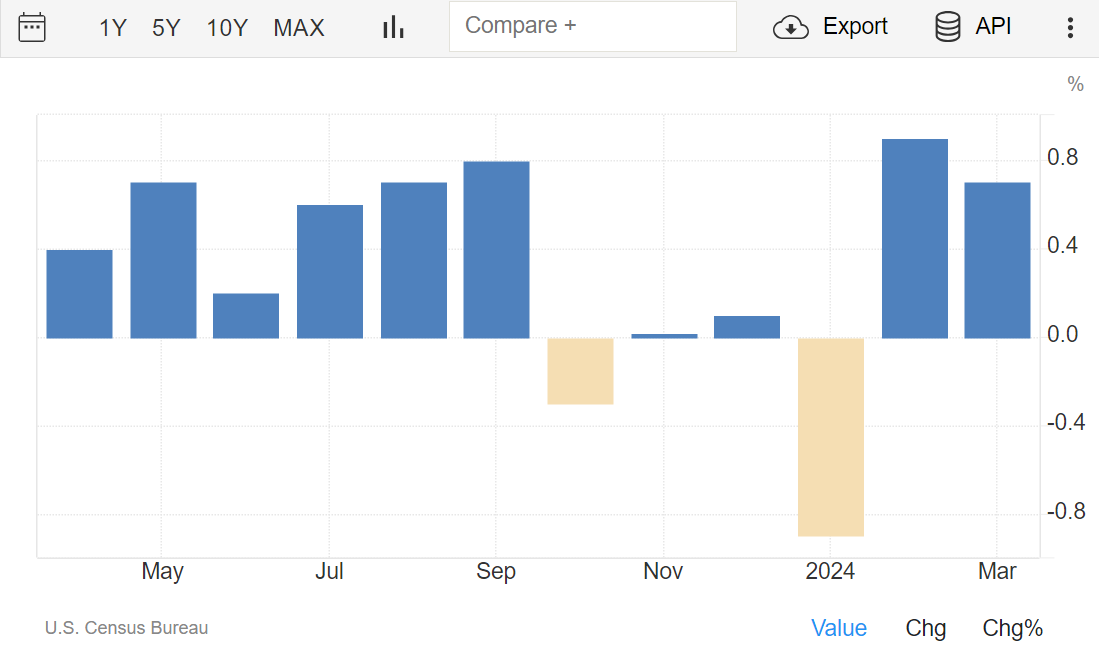
March paints a picture of resilience in consumer spending, surpassing economists' expectations despite ongoing inflationary pressures. Retail sales increased by 0.7% in March, nearly double the forecasted rate, following a 0.9% rise in February. Even after excluding gas prices, which have been climbing, retail sales still showed a solid increase of 0.6%. While retail sales provide insight into consumer spending, they don't cover services like travel and hotel stays. However, the restaurant category saw a modest uptick of 0.4%.
Retail sales figures aren't adjusted for inflation, which rose by 0.4% from February to March. Despite this, retailers still saw solid gains in sales, indicating genuine consumer demand. Inflation remains a concern, driven by factors like higher gas prices, rents, and auto insurance. That as well the strong retail sales report will likely delay a cut by the Federal Reserve to interest rates that many had anticipated at the next meeting. Andrew Hunter, deputy chief U.S. economist at Capital Economics, doesn't think any rate cut will happen until September.
Consumer behavior remains robust in spending due to reduced optimism about economic prospects, high living costs, and borrowing expenses. Consumers are becoming more selective in their purchasing decisions, focusing on value and essentials.
Unraveling Market Responses Amid Geopolitical Tensions: A Closer Look at Recent Financial Movements
In a week marked by significant geopolitical events, financial markets have responded with a mixture of anticipation and caution. The recent airstrike by Iran on Israeli soil has not only heightened tensions in the Middle East but also sent ripples through global financial systems, underscoring the intricate relationship between geopolitical stability and economic predictability.
The Immediate Impact on Oil and Gold
The attack, which targeted Israeli military facilities, spurred a notable shift in commodity markets. Oil prices, which had peaked on Friday in response to rising hostilities, saw a dip with Brent crude falling below $90 a barrel and US WTI crude dropping by 1% to $84.50. This fluctuation reflects the market's nervousness about potential disruptions in oil supply, a critical concern given the Middle East's pivotal role in global oil production.
Conversely, gold, a traditional safe haven in times of uncertainty, saw its price increase. Spot gold rose by 0.3% to $2,349 per ounce, nearing its all-time high, driven by investors' flight to safety amid escalating fears of further conflict.
Global Stock Market Reactions
The stock markets have exhibited mixed responses. Europe’s Stoxx 600 index modestly increased, while major indices like Germany’s DAX and France’s CAC 40 also saw gains. However, the FTSE 100 in London declined slightly by 0.4%. In Asia, the Hong Kong Hang Seng Index and Japan's Nikkei 225 both experienced declines, whereas the Shanghai Composite Index in China bucked the trend with a rise of 1.3%.
This divergence highlights the global nature of financial markets and their varying sensitivity to geopolitical events. Markets closer to the epicenter of the conflict showed more pronounced negative reactions, whereas others seemed to benefit from reallocations within the global investment landscape.
The Role of International Bodies
The International Energy Agency (IEA) has remarked on the increased volatility in oil markets, emphasizing the importance of oil security in the current climate. The agency's insights are a stark reminder of the broader implications of regional conflicts on global economic stability.
Strategic Moves by Nations and Corporations
In the wake of these developments, Israel's government has been deliberative in its response, with strategic meetings to decide the next course of action. Meanwhile, the U.S. has opted for a cautious stance, choosing not to engage directly in military retaliation, which has offered some reassurance to the markets, as indicated by a modest uptick in U.S. stock futures.
Looking Ahead
As investors and analysts watch these unfolding events, the key takeaway is the interconnectedness of global markets and geopolitical stability. The immediate future of the markets will heavily depend on the progression of this conflict and the strategic decisions made by key global players.
In these volatile times, investors are advised to stay informed and consider hedging risks by diversifying their investment portfolios, not only across different financial instruments but also geographically. As history has shown, turbulence is often short-lived, but the lessons learned about the resilience of global markets can provide valuable insights for future strategies.
This dynamic scenario serves as a critical case study for both economic and political analysts, as it combines elements of international relations, market psychology, and strategic economic planning, illustrating just how globally intertwined our modern world has become.
Source - https://www.cnn.com/2024/04/14/markets/asian-markets-gold-oil-iran-attack-israel-intl-hnk/index.html
Subscribe to:
Posts (Atom)