Thursday, April 18, 2024

Russia is expected to grow faster than all advanced economies this year

Russia is expected to grow faster than all advanced economies this year

This article is about Russia's expected growth in the next year and how the International Monetary Fund predicts that it will be the fastest to grow in the coming calendar year. The growth is expected to be 3.2% in 2024 and would be greater than all other larger economies including the United States. This forecast is surprising to Western nations who had hoped to isolate the Russian economy after invading Ukraine in 2022. The article then discusses the self-sufficiency of Russia and how expanded during the war. From a political standpoint, the International Monetary Fund touches on the predicted impacts of the war with Ukraine and affects the political and social standing of Putin as he promises Russians to raise their living standards. Similar to what we discussed in class, Putin plans to raise living standards by spending money on education, healthcare, and public infrastructure which we learned are effective ways of raising the standard of living of a country.


Link: https://www.cnbc.com/2024/04/17/russia-forecast-to-grow-faster-than-advanced-economies-in-2024-imf.html

Wednesday, April 17, 2024

How to Plan for a Recession

The idea of experiencing a recession in the future is something that most Americans are used to, especially after everything that has happened in the last four years. This article dives into how to combat such economic downturns so that readers can understand what can be done to escape the negative effects that go along with recessions. The first way to handle the decrease in money supply would be putting your extra cash in a high interest insurance account. Securing an emergency fund, will help with keeping the value of your savings high and reducing the likelihood of needing to borrow because of its liquidity. It is important to note that living within you means during good economic stability will help reduce the need to borrow when food and gas prices rise in economic downturns. The article suggests that trying to live off of one payroll instead of two for married couples is a good habit that will help reduce spending and increase savings for emergencies. Diversifying your income streams was another suggestion which can help increase job security by having multiple places that one can put their extra time into for pay. Next is investing, and just like any good financial advisor this article preaches about investing in the long run and diversifying your portfolio. Diversifying helps with managing risk within the market, making sure you do not invest in one particular section of the economy mitigates the risk of completely loosing everything if that section collapses. They also emphasized the importance of investing for the long run, saying that you haven’t lost the money until you sell, so it is important to be aware that panic is what often leads to even worse situations. When prices are down it is almost like they are on sale, so in some situations it can be beneficial to take advantage of that if you have the means. As long as you are not invested in one place, this will help mitigate any major losses seen throughout the entire economy. As someone who plans to be a part of the workforce in the next two years, I thought this article was helpful in outlining some of the priorities I should be setting for myself. 

7 Ways to Recession-Proof Your Life


U.S. economy will see ‘more things break’ in 2025 if rates stay high, strategist says


In this article, it explains how traditional monetary policy is broken in the sense that it takes longer for the economy to see real effects. Another problem that was mentioned is if interest rates stay high into 2025 there could be major problems as many people and companies will be refinancing around that time causing them to feel the effects of high interest rates which on analysis suggested could cause large problems.


https://www.cnbc.com/2024/04/16/us-economy-will-see-more-things-break-in-2025-if-rates-stay-high-strategist.html

Monday, April 15, 2024

US March's Retail Sales Rise Much More Than Expected

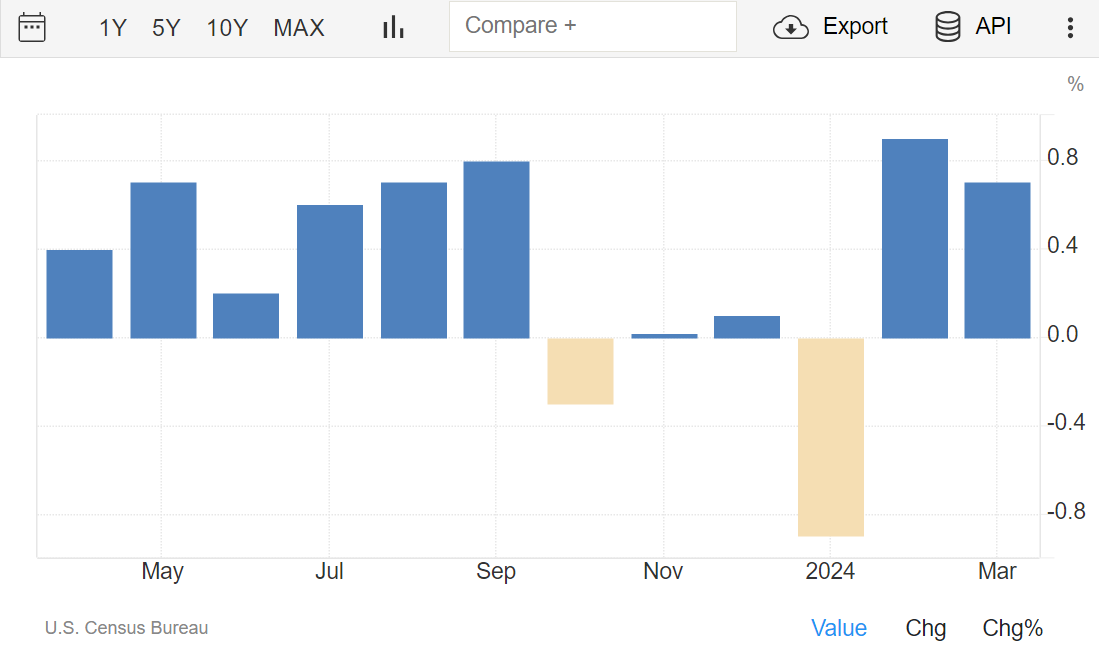
Retail sales surge 0.7% in March as Americans seem unfazed by higher prices with jobs plentiful

March paints a picture of resilience in consumer spending, surpassing economists' expectations despite ongoing inflationary pressures. Retail sales increased by 0.7% in March, nearly double the forecasted rate, following a 0.9% rise in February. Even after excluding gas prices, which have been climbing, retail sales still showed a solid increase of 0.6%. While retail sales provide insight into consumer spending, they don't cover services like travel and hotel stays. However, the restaurant category saw a modest uptick of 0.4%.

Retail sales figures aren't adjusted for inflation, which rose by 0.4% from February to March. Despite this, retailers still saw solid gains in sales, indicating genuine consumer demand. Inflation remains a concern, driven by factors like higher gas prices, rents, and auto insurance. That as well the strong retail sales report will likely delay a cut by the Federal Reserve to interest rates that many had anticipated at the next meeting. Andrew Hunter, deputy chief U.S. economist at Capital Economics, doesn't think any rate cut will happen until September. 

Consumer behavior remains robust in spending due to reduced optimism about economic prospects, high living costs, and borrowing expenses. Consumers are becoming more selective in their purchasing decisions, focusing on value and essentials.


Unraveling Market Responses Amid Geopolitical Tensions: A Closer Look at Recent Financial Movements

In a week marked by significant geopolitical events, financial markets have responded with a mixture of anticipation and caution. The recent airstrike by Iran on Israeli soil has not only heightened tensions in the Middle East but also sent ripples through global financial systems, underscoring the intricate relationship between geopolitical stability and economic predictability.

The Immediate Impact on Oil and Gold

The attack, which targeted Israeli military facilities, spurred a notable shift in commodity markets. Oil prices, which had peaked on Friday in response to rising hostilities, saw a dip with Brent crude falling below $90 a barrel and US WTI crude dropping by 1% to $84.50. This fluctuation reflects the market's nervousness about potential disruptions in oil supply, a critical concern given the Middle East's pivotal role in global oil production.

Conversely, gold, a traditional safe haven in times of uncertainty, saw its price increase. Spot gold rose by 0.3% to $2,349 per ounce, nearing its all-time high, driven by investors' flight to safety amid escalating fears of further conflict.

Global Stock Market Reactions

The stock markets have exhibited mixed responses. Europe’s Stoxx 600 index modestly increased, while major indices like Germany’s DAX and France’s CAC 40 also saw gains. However, the FTSE 100 in London declined slightly by 0.4%. In Asia, the Hong Kong Hang Seng Index and Japan's Nikkei 225 both experienced declines, whereas the Shanghai Composite Index in China bucked the trend with a rise of 1.3%.

This divergence highlights the global nature of financial markets and their varying sensitivity to geopolitical events. Markets closer to the epicenter of the conflict showed more pronounced negative reactions, whereas others seemed to benefit from reallocations within the global investment landscape.

The Role of International Bodies

The International Energy Agency (IEA) has remarked on the increased volatility in oil markets, emphasizing the importance of oil security in the current climate. The agency's insights are a stark reminder of the broader implications of regional conflicts on global economic stability.

Strategic Moves by Nations and Corporations

In the wake of these developments, Israel's government has been deliberative in its response, with strategic meetings to decide the next course of action. Meanwhile, the U.S. has opted for a cautious stance, choosing not to engage directly in military retaliation, which has offered some reassurance to the markets, as indicated by a modest uptick in U.S. stock futures.

Looking Ahead

As investors and analysts watch these unfolding events, the key takeaway is the interconnectedness of global markets and geopolitical stability. The immediate future of the markets will heavily depend on the progression of this conflict and the strategic decisions made by key global players.

In these volatile times, investors are advised to stay informed and consider hedging risks by diversifying their investment portfolios, not only across different financial instruments but also geographically. As history has shown, turbulence is often short-lived, but the lessons learned about the resilience of global markets can provide valuable insights for future strategies.

This dynamic scenario serves as a critical case study for both economic and political analysts, as it combines elements of international relations, market psychology, and strategic economic planning, illustrating just how globally intertwined our modern world has become.


Source - https://www.cnn.com/2024/04/14/markets/asian-markets-gold-oil-iran-attack-israel-intl-hnk/index.html

Friday, April 12, 2024

When will Americans see those interest-rate cuts?


When will Americans see those interest-rate cuts?

Link:https://www.economist.com/finance-and-economics/2024/04/10/when-will-americans-see-those-interest-rate-cuts


In the wake of robust growth, this article says inflation is only looking stickier. For multiple months now, inflation has come in higher than forecasted and at this rate inflation at the end of the year will be hitting 4% rather than the Fed’s target 2%. Because of this the Fed is still not going to cut rates. The Fed not cutting rates will remain consistent with Powell’s approaches to the past and remain data-dependent before any decisions are made in terms of monetary policy. It will be interesting to see how the PCE, when it comes out, is interpreted. 


In terms of discussion that we’ve had in class about how politics can affect decisions made, I thought it was interesting that the article talked about how this might look for Biden with the election coming up. 


To perfectly sum up what this may mean for our near and distant future the article concluded with this quote: “The general conclusion today is that although growth has remained impressively strong, it now appears to be bumping up against the economy’s supply limits, and is therefore translating into persistent inflationary pressure. That calls for tight, not loose, monetary policy. The Fed, already cautious about cutting rates when inflation figures were more co-operative, is likely to be even more wary now.”


Thursday, April 11, 2024

Soft Landing or No Landing? Fed’s Economic Picture Gets Complicated.

     In the article “Soft Landing or No Landing? Fed’s Economic Picture Gets Complicated” published in The New York Times by Jeanna Smialek, it delves into the topic of stubborn inflation and strong growth that could keep the Federal Reserve wary about interest rate cuts. 

    The article discusses unexpected economic trends in 2024, contrary to previous predictions of a "soft landing" marked by declining inflation and moderate growth. Instead, the economy is booming with prices rising more quickly than anticipated. This challenges the Federal Reserve's goal of controlling inflation at a steady 2 percent, potentially leading to prolonged high-interest rates. Recent data shows stubborn inflation, prompting caution among Fed officials about rate cuts. Despite initial expectations of three rate cuts in 2024, investors now anticipate fewer cuts, reflecting the economy's resilience. Fed Chair Jerome H. Powell emphasizes patience, citing strong growth, while some policymakers suggest no rate cuts at all this year.

This cautious approach may delay rate cuts until later in the year or even prompt a rate increase if inflation remains stagnant. The article highlights the potential impact on households and President Biden's political standing ahead of the 2024 election. Overall, it underscores the uncertainty surrounding future Fed policy and its implications for the economy.


Wednesday, April 10, 2024

Market Turbulence: Dow Dives and Treasury Yields Soar Amid Inflation Concerns

In a notable market event on April 9, 2024, the financial world witnessed significant volatility as stocks took a plunge following the release of March's inflation data, which came in stronger than many had anticipated. This unexpected rise in inflation figures has led to a reconsideration of the timing of anticipated interest rate cuts by the Federal Reserve, impacting investor sentiment and market dynamics.

The Numbers Speak Volumes

The Dow Jones Industrial Average faced a substantial decline, dropping 577 points or 1.5%, while both the S&P 500 and Nasdaq Composite saw decreases of 1.3% each. This downturn was not isolated to specific sectors; all major sectors within the S&P 500 painted the market red, with real estate experiencing the most significant loss at about 4%.

This market reaction comes on the heels of a strong first quarter for the year, where the S&P 500 rallied 10% for its best first-quarter gain in five years. The optimism was momentarily dampened as the Consumer Price Index (CPI) for March reported a 0.4% rise for the month and a 3.5% increase year-over-year, slightly above the forecasts. Similarly, the Core CPI, which excludes volatile food and energy prices, accelerated more than expected.

Fed Rate Cut Expectations Adjusted

The strong inflation data has led to a shift in expectations regarding the Federal Reserve's monetary policy moves. According to the CME FedWatch Tool, the likelihood of a rate cut at the Fed's June meeting has now diminished to just 20.6%. Market participants are recalibrating their bets, with many now anticipating that any potential rate cut could be delayed until the Fed's September meeting.

Treasury Yields on the Rise

The treasury yields, particularly the 10-year and 2-year yields, have responded to the inflation news with significant spikes. The 10-year Treasury yield surged back above 4.5%, while the 2-year yield approached nearly 5%. These movements underscore the market's anticipation of a more aggressive stance by the Federal Reserve to combat inflation, which remains stubbornly high.

Sectoral Impacts and Investor Sentiment

The impact of the inflation data and adjusted expectations for Federal Reserve policy was felt across various sectors. Financial stocks such as JPMorgan Chase and industrial giants like Honeywell saw declines, reflecting concerns over the impact of higher rates on economic growth. Technology stocks, a sector that had been on a hot streak, also experienced pullbacks, with giants like Microsoft and Apple each retreating by 1%.

 Looking Forward

Despite the day's downturn, market analysts and investors are keeping an eye on the broader picture. Many see this as a temporary adjustment rather than a signal of a longer-term bear market. The upcoming release of the Fed's meeting minutes and further inflation reports will be closely watched for indications of future policy directions and their implications for the markets.


As we navigate through these volatile times, the importance of monitoring inflation trends and Federal Reserve policy decisions remains paramount. The market's reaction to the latest inflation data serves as a reminder of the intricate balance between monetary policy, investor expectations, and the real economy.


Source - https://www.cnbc.com/2024/04/09/stock-market-today-live-updates.html

Monday, April 8, 2024

How to build a global currency

 The article discusses the evolution of the Indian rupee's international standing over the past decades, contrasting its historic presence in the global market with its current marginal role. Despite India's economic stature as the world's fifth-largest economy, the rupee accounts for less than 2% of international currency transactions. Prime Minister Narendra Modi has expressed a desire to elevate the rupee's global prominence, urging policymakers to enhance its accessibility. However, historical precedent suggests that while leaders often advocate for their currency's global recognition, enacting the necessary reforms remains a challenge.

The piece explores the potential benefits and challenges associated with establishing a currency's international prominence, drawing parallels with the experiences of other countries such as Japan and China. While India has taken strides to bolster the rupee's international appeal, notably through inclusion in global financial indices and facilitating foreign investment, significant barriers remain. The article suggests that achieving global currency status requires extensive economic reforms, akin to those undertaken by Japan in the past, which may entail considerable disruption to existing economic structures. Without internal impetus for change, the prospect of India's rupee ascending to global currency status remains uncertain, with the article underscoring the need for domestic initiative in driving such transformation.

https://www.economist.com/finance-and-economics/2024/04/04/how-to-build-a-global-currency

Sunday, April 7, 2024

“The Fed and Political Independence: It’s Complicated”

This article discusses how Joseph Sternberg, who writes for the Wall Street Journal, thinks the Fed has created the worst inflation in over forty years through excessive tightening. He states that “the central bank could cast the economy into a recession for no good reason” and feels that the Fed should be held accountable similarly to elected officials. Sternberg believes that the Fed should be held politically responsible by having state governors appoint Fed regional bank boards (which then appoint the regional bank president) and empower “the US president to fire at will members of the Board of Governors.” Moreover, the article's author, Alexander William Salter,  agrees with Sternberg and believes that Congress should change the Fed’s mandate to focus solely on price stability. He states that the Fed should be required to target the price level or nominal GDP. The Fed can choose the metric, but it must stick with it, and its leaders must be accountable for hitting the target on an ongoing basis. The author believes that failure should result in punishment, up to and including dismissal, and that the Fed’s strategy of using interest paid on reserves to implement monetary policy gives it too much power. The Fed can arbitrarily increase its balance sheet, giving it control over credit allocation. Essentially, the Fed pays banks not to lend, incentivizing banks to keep more significant reserve balances in their Fed accounts. The author gives more instances to regulate the Fed and remove some of its power. 


https://www.aier.org/article/the-fed-and-political-independence-its-complicated/